



Aesthetic medicine has advanced rapidly over the past decade. Aestheic technologies have become more refined, treatment options more numerous, and expectations – both clinical and patient-driven – increasingly sophisticated or even over exaggereated. Yet despite these advances, aesthetic outcomes often plateau, variability between patients remains high, and repeated interventions do not always translate into sustained improvement.
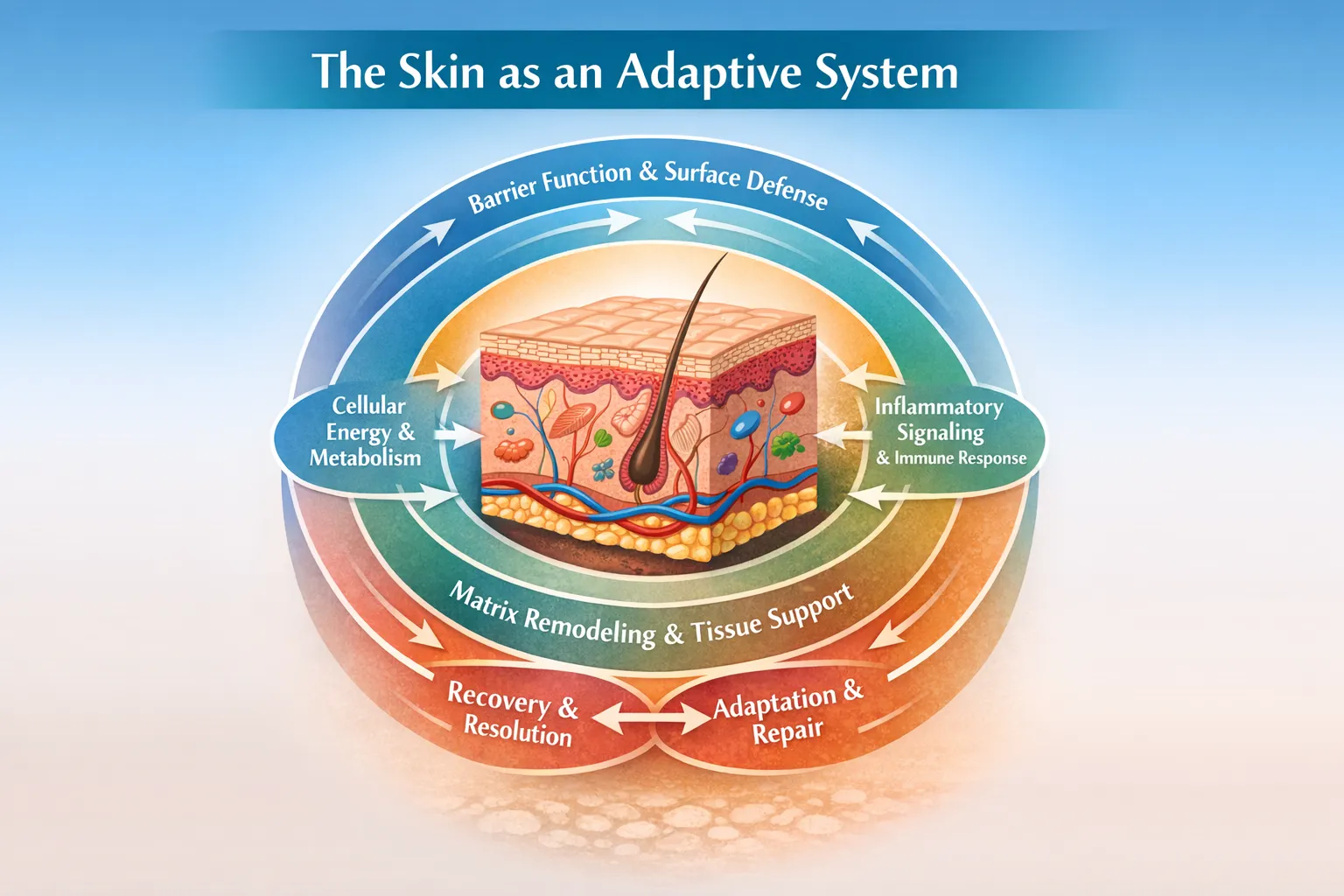
This paradox highlights a central challenge: skin does not respond to treatments in isolation. It responds as a biological system – a biological framework – adaptive, resource-dependent, and shaped by its cumulative history of stress, recovery, and signaling.
The previous articles in this series have explored key dimensions of this reality: the distinction between skin appearance and skin quality, skin inflammation as a continuum rather than a binary state, and how different aesthetic technologies interact with skin biology. This final article brings those perspectives together into a practical biological framework, one that helps explain why some treatment strategies create lasting improvements while others fail to compound over time.
Rather than asking which treatment is best, the more relevant question becomes:
How does a given intervention interact with the skin’s capacity to respond, recover, and adapt?
When we stop asking what a treatment can do to the skin – and start asking what the skin is capable of doing at that moment – aesthetic outcomes change fundamentally.”
Skin is often approached as a collection of targets: pigment, vessels, wrinkles, laxity, texture. While clinically useful, this framing can obscure the fact that all visible outcomes are downstream of system-level processes: barrier regulation, immune signaling, cellular metabolism, extracellular matrix remodeling, and vascular support.
At the biological level, the skin continuously balances competing priorities. It must defend, repair, adapt, and conserve resources simultaneously. Treatments do not simply “add” effects – they shift how the system allocates energy and signaling.
This explains why identical interventions can lead to markedly different aesthetic outcomes depending on baseline skin status, inflammatory load, metabolic capacity, and timing. It also explains why repeated treatments may yield diminishing returns if recovery and resolution are not adequately supported.
A sustainable strategy therefore requires moving from intervention-centric thinking to biological framework-centric planning.
Inflammation, Stress, and the Cost of Adaptation
Inflammation is often framed as something to suppress or avoid. However, inflammation is a fundamental biological mechanism – essential for defense, repair, and adaptation. The issue is not inflammation itself, but whether it resolves appropriately – whether that inflammation induced is supportive or destructive.
Acute, well-regulated inflammatory signaling supports regeneration. Chronic, unresolved skin inflammation signaling shifts biology toward survival mode. In this state, resources are diverted away from long-term tissue quality toward immediate defense and containment.
From a clinical perspective, this distinction is critical. Treatments that repeatedly activate stress pathways without sufficient resolution may appear effective short-term, yet gradually erode the skin’s adaptive capacity. Over time, this can manifest as prolonged downtime, increased sensitivity, unpredictable responses, or a lack of cumulative benefit.
Understanding inflammation as a continuum of signaling states allows treatment planning to focus not only on activation, but on resolution and skin recovery.
Capacity, Recovery, and Biological Timing
Every treatment imposes a biological cost, a cost on nutrients, energy, cellular prioritization. This cost is not inherently negative – but it must be matched to the skin’s ability to recover and the bodies ability to support this cost.
Skin recovery is not passive. It is an active, resource-intensive phase involving cellular repair, matrix remodeling, immune recalibration, and metabolic normalization – all processes that cost significant amount of energy, metaboligc activity and nutrients. When recovery is incomplete, subsequent interventions stack stress rather than benefit.
This has direct implications for sequencing and combination therapies. Treatments performed too frequently may blunt adaptive responses. Treatments spaced too far apart may fail to build momentum. Optimal timing aligns intervention with the declining phase of prior signaling, allowing effects to accumulate rather than reset.
Clinical success, therefore, depends less on intensity and more on matching the biological rythm.
Combination Therapies as Strategic Modulation
Combination therapies are often justified pragmatically – addressing multiple concerns at once. Biologically, however, their value lies in how they modulate different layers of the system.
Broadly, interventions can be understood as acting across complementary domains:
- Outside–in support, reinforcing barrier function and surface signaling
- Inside–out modulation, influencing cellular communication and tissue behavior
- Structural stimulation, reshaping matrix organization and mechanical integrity
- Metabolic and nutritional support, sustaining the energy demands of adaptation
When aligned, these domains support one another. Barrier integrity reduces inflammatory noise. Controlled signaling improves tissue responsiveness. Structural remodeling benefits from metabolic readiness. The result is not just additive improvement, but coherent system behavior.
When misaligned, however, combination therapies may compete for limited resources, increasing stress without improving aesthetic outcomes.
The distinction lies not in the number of treatments used, but in how they are sequenced, balanced, and contextualized.

From Protocols to Principles
One of the limitations of protocol-driven aesthetics is that protocols assume stability. Biology is anything but stable. In principle every single person has a different skin – driven by lifestyle, life choices, genetics, living location, diseases, work, family and all other things surrounding us… Skin evolves with age, environment, hormonal status, cumulative exposure, and prior interventions.
Whenever I am asked about so what should go first, they often received the answer “that depends” – and it truly does depend on so many factors that are often overlooked, misunderstood, or simply ignored – often because it did not fit into a nice “marketing story” of where the specific product or technology actually fits
A biological framework-based approach does not discard protocols – it anchors them in principles. It encourages clinicians to ask:
- What state is the skin currently in?
- What signaling does it need – and what does it need less of?
- Is the next intervention likely to build capacity, or consume it?
- Are we supporting resolution as much as activation?
This shift does not complicate practice – it clarifies it. It allows technologies, injectables, light-based therapies, and supportive interventions to be selected not as isolated solutions, but as tools within a coherent biological strategy.
Conclusion: Toward Sustainable Aesthetic Outcomes
Sustainable aesthetic outcomes are rarely the result of a single intervention. They emerge from alignment – between skin biology, timing, and intent.
By viewing skin as an adaptive system, inflammation as a regulatory signal, and treatments as modulators rather than fixes, clinical practice moves beyond short-term correction toward long-term quality.
This perspective does not diminish the value of modern aesthetic technologies. On the contrary, it places them in their proper context – as powerful tools whose impact depends on how intelligently they are applied.
Ultimately, the most effective strategies are those that respect not just what skin can do, but how it does it.
What Comes Next?
This series has focused on building a shared biological language for understanding skin behavior, treatment response, and long-term sustainable aesthetic outcomes. The next phase will move closer to clinical application – exploring how these principles translate into specific technology categories and decision-making processes.
Upcoming articles will examine:
- Light-based therapies as modulators of inflammatory signaling, cellular metabolism, and skin recovery dynamics
- Bioregenerative skin boosters and hybrid injectables as inside–out drivers of tissue behavior rather than volumetric tools
- Active cleansing and resurfacing technologies that influence barrier integrity and treatment readiness
- Microneedling and structural stimulation in the context of timing, depth, and cumulative load
- Biological readiness – how to assess when skin is prepared to respond, and when intervention risks diminishing returns
- Skin analytics and data-driven evaluation, supporting more individualized and adaptive treatment strategies
Rather than isolating these technologies, future articles will focus on how they interact – biologically and temporally – within the same skin system or biological framework. The goal is not to define new protocols, but to refine the way we think about sequencing, capacity, and sustainable improvement.
References
This article is inspired by a body of peer-reviewed research and clinical literature, including but not limited to – if you have any questions, reach out to us:
Elias PM.
Skin barrier function.
Current Allergy and Asthma Reports. 2008;8(4):299–305.
https://doi.org/10.1007/s11882-008-0048-0
https://pubmed.ncbi.nlm.nih.gov/18606081/
Medzhitov R.
Origin and physiological roles of inflammation.
Nature. 2008;454(7203):428–435.
https://doi.org/10.1038/nature07201
https://www.nature.com/articles/nature07201
Nathan C, Ding A.
Nonresolving inflammation.
Cell. 2010;140(6):871–882.
https://doi.org/10.1016/j.cell.2010.02.029
https://www.cell.com/cell/fulltext/S0092-8674(10)00182-0
Singer AJ, Clark RAF.
Cutaneous wound healing.
New England Journal of Medicine. 1999;341(10):738–746.
https://doi.org/10.1056/NEJM199909023411006
https://www.nejm.org/doi/full/10.1056/NEJM199909023411006
Fisher GJ, Varani J, Voorhees JJ.
Looking older: fibroblast collapse and therapeutic implications.
Archives of Dermatology. 2008;144(5):666–672.
https://doi.org/10.1001/archderm.144.5.666
https://jamanetwork.com/journals/jamadermatology/article-abstract/419693
Quan T, Fisher GJ.
Role of age-associated alterations of the dermal extracellular matrix microenvironment in human skin aging.
Gerontology. 2015;61(5):427–434.
https://doi.org/10.1159/000371708
https://karger.com/ger/article-abstract/61/5/427/147882
Sorrell JM, Caplan AI.
Fibroblast heterogeneity: more than skin deep.
Cell and Tissue Research. 2004;317(1):49–57.
https://doi.org/10.1242/jcs.01005
https://pubmed.ncbi.nlm.nih.gov/14754903/
Rinnerthaler M, et al.
Oxidative stress in aging human skin.
Biomolecules. 2015;5(2):545–589.
https://doi.org/10.3390/biom5020545
https://pmc.ncbi.nlm.nih.gov/articles/PMC4496685/
Kitano H.
Systems biology: a brief overview.
Science. 2002;295(5560):1662–1664.
https://doi.org/10.1126/science.1069492
https://www.science.org/doi/10.1126/science.1069492
Sparavigna A, et al.
Efficacy and tolerance of an injectable medical device containing stable hybrid cooperative complexes of high- and low-molecular-weight hyaluronic acid.
Clinical, Cosmetic and Investigational Dermatology. 2016;9:297–305.
https://doi.org/10.2147/CCID.S114450
https://www.dovepress.com/efficacy-and-tolerance-of-an-injectable-medical-device-containing-stab-peer-reviewed-fulltext-article-CCID
Avci P, et al.
Low-level laser (light) therapy in skin: stimulating, healing, restoring.
Seminars in Cutaneous Medicine and Surgery. 2013;32(1):41–52.
https://doi.org/10.12788/j.sder.0006
https://pubmed.ncbi.nlm.nih.gov/24049929/
Hamblin MR.
Mechanisms and applications of the anti-inflammatory effects of photobiomodulation.
AIMS Biophysics. 2017;4(3):337–361.
https://doi.org/10.3934/biophy.2017.3.337
https://www.aimspress.com/article/10.3934/biophy.2017.3.337
Pilkington SM, et al.
Inflammaging and the skin.
Journal of Investigative Dermatology. 2021;141(4S):1089–1095.
https://doi.org/10.1016/j.jid.2020.11.006
https://www.jidonline.org/article/S0022-202X(20)32294-6/fulltext
 English