



Combination treatments are often positioned as the natural evolution of aesthetic medicine. Skin is complex, so addressing it from multiple angles seems both logical and necessary. In theory, combining modalities should enhance outcomes by targeting different parameters simultaneously.
In practice, combination treatments are where some of the most impressive results – and some of the most persistent limitations emerge.
The difference is rarely the choice of technologies. It lies in how combinations interact with skin biology over time. Hence, over understanding of not only the true impact of a technology towards the skin, but also relative to treatment sequencing and the interaction between technologies becomes important
True synergy in aesthetic medicine is not created by just adding more treatments,
but by aligning biological signals from each indivudal treatment with the skin’s ability to integrate them
There is a widespread assumption that combining treatments automatically creates synergy. Biologically, this is not the case.
Synergy does not arise from only stacking inputs. It emerges when multiple interventions are interpreted and integrated by the skin in a way that enhances adaptation without triggering defensive escalation.
When combinations succeed, they do so because biological signals:
- complement rather than compete – ensuring the technologies do not go against each other
- arrive within the skin’s adaptive window – which treatments come first, next and so on
- allow resolution to occur before further inputs are introduced – understand biological effect
When combinations fail, it is usually because these conditions are not met – even when each individual treatment is effective on its own.
Every Combination Introduces Cumulative Biological Demand
Each aesthetic intervention places a demand on the skin. That demand may be subtle or substantial, but it is never neutral. Regardless if it the most mild cosmetic or spa treatment – or the most aggressive laser treatment or surgery.
When treatments are layered without regard for biological resolution, the skin is forced to prioritize survival functions over refinement. In this state, inflammatory signaling may remain elevated, recovery processes may be incomplete, and cellular resources are diverted away from long-term adaptation.
Importantly, this does not always result in immediate adverse events. More often, it manifests as:
- effect of individual treatments not as good as expected
- increasing sensitivity to products or treatments
- longer recovery periods until the skin settles again
- reduced tolerance to future treatments
From the outside, it may appear that the skin has “stopped responding.” Biologically, it has simply shifted priorities
A Functional Way to Think About Combination Treatments
One reason combination therapies are difficult to evaluate is that they are often discussed as collections of technological modalities rather than as coordinated biological strategies.
A more useful approach is to think about combinations based on how and where interventions act within the skin system – to the extend known, how the cells they impact respond to the treatment, and for how long time the effect of the treatment last.
From this perspective, most combination treatments operate across four complementary domains.
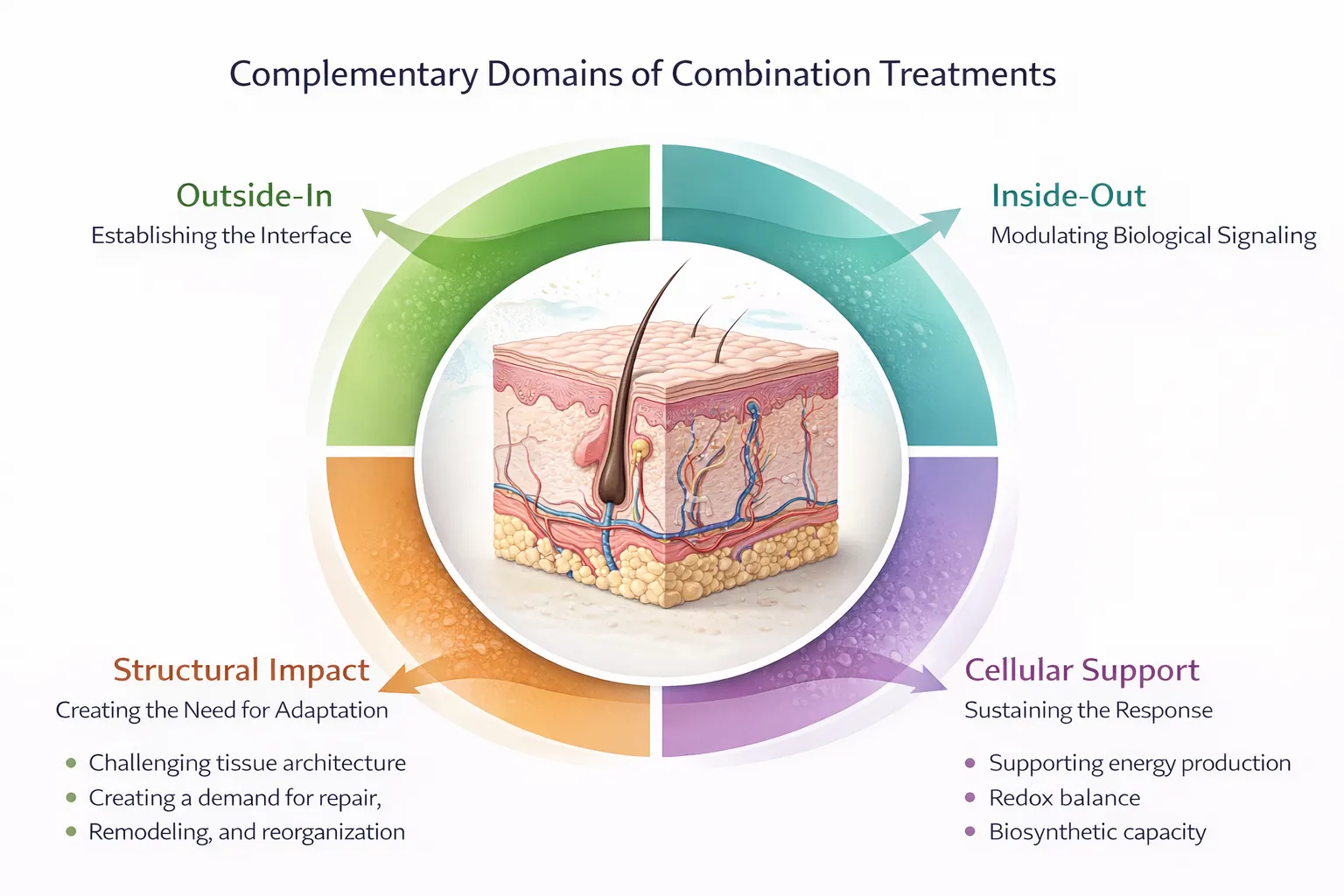
1) Outside–In: Establishing the Foundation
Outside–in approaches primarily influence the skin’s interface with its environment. They affect barrier integrity, hydration dynamics, surface renewal, and microbial balance – a strategic foundation for the actual working of the skin – protecting what is inside us from the outside world.
While these interventions rarely drive dramatic change on their own, they strongly influence how predictable and receptive the skin becomes. When the interface is compromised or broken, deeper or more demanding interventions often produce inconsistent or blunted responses.
Within combination strategies, outside–in approaches function as stabilizers and enablers. They prepare the system to interpret subsequent inputs more coherently.
2) Inside–Out: Modulating Biological Signaling
Inside–out approaches influence cellular communication, mitochondrial activity, fibroblast activity, inflammatory tone, and metabolic signaling.
Rather than relying on disruption, these interventions guide how cells allocate energy, produce foundational components like collagen, elastin and hyaluronic acid. But also how they respond to stress, and coordinate repair. Their effectiveness depends heavily on the existing biological state of the skin.
In combination strategies, inside–out approaches often act as amplifiers. They do not replace other interventions but influence the quality and efficiency of the responses those interventions initiate
3) Structural Impact: Creating the Need for Adaptation
Structural interventions deliberately challenge tissue architecture. They introduce controlled disruption that demands repair, remodeling, and reorganization.
When used appropriately, structural inputs can drive meaningful and lasting change. When used without sufficient support or recovery, they can shift the system toward repeated defense rather than adaptation.
In combination treatments, structural interventions are typically the most biologically demanding. Their success depends less on their intensity and more on what surrounds them – before, during, and after.
4) Cellular Support: Sustaining the Response
No adaptive process is free.
Cellular support strategies aim to ensure that the skin has the metabolic and biochemical resources required to complete the responses initiated by other treatments. This includes supporting energy production, nutrients, metabolic activity, redox balance, and biosynthetic capacity.
These interventions rarely produce visible change in isolation. Their importance becomes apparent over time, as they influence whether early improvements are consolidated or gradually lost.
Within combination strategies, cellular support often determines whether outcomes plateau or continue to evolve.
Why Combinations Plateau or Backfire
Combination treatments most often fail not because they are too aggressive, but because they are too compressed or poorly aligned.
When multiple stress-inducing inputs are introduced within the same biological window, or when supportive and modulatory inputs are delivered into an unresolved defensive state, signals blur into noise. The skin cannot distinguish guidance from threat.
In such cases:
- short-term appearance may improve
- early results may look promising
- long-term quality and adaptability decline
The limitation is not technological. It is biological.
Sequence Matters More Than Selection
One of the most overlooked aspects of combination therapy is sequencing.
The order in which interventions are introduced determines whether signals are interpreted as cooperative or conflicting. Modulatory inputs delivered into a defensive state are often muted. Structural challenges layered onto unresolved responses amplify inflammatory load.
Effective combination strategies do not require fewer tools. They require biological timing.
Understanding when the skin is receptive, adaptive, or saturated matters more than choosing the “right” combination on paper.
When understanding the sequence, the recovery period becomes equally as important.
Recovery is not simply time between sessions. It is the period during which the biological meaning of an intervention is resolved. Without sufficient recovery, even well-designed combinations gradually erode capacity.
With appropriate recovery, combinations can extend what the skin is able to tolerate and integrate over time.
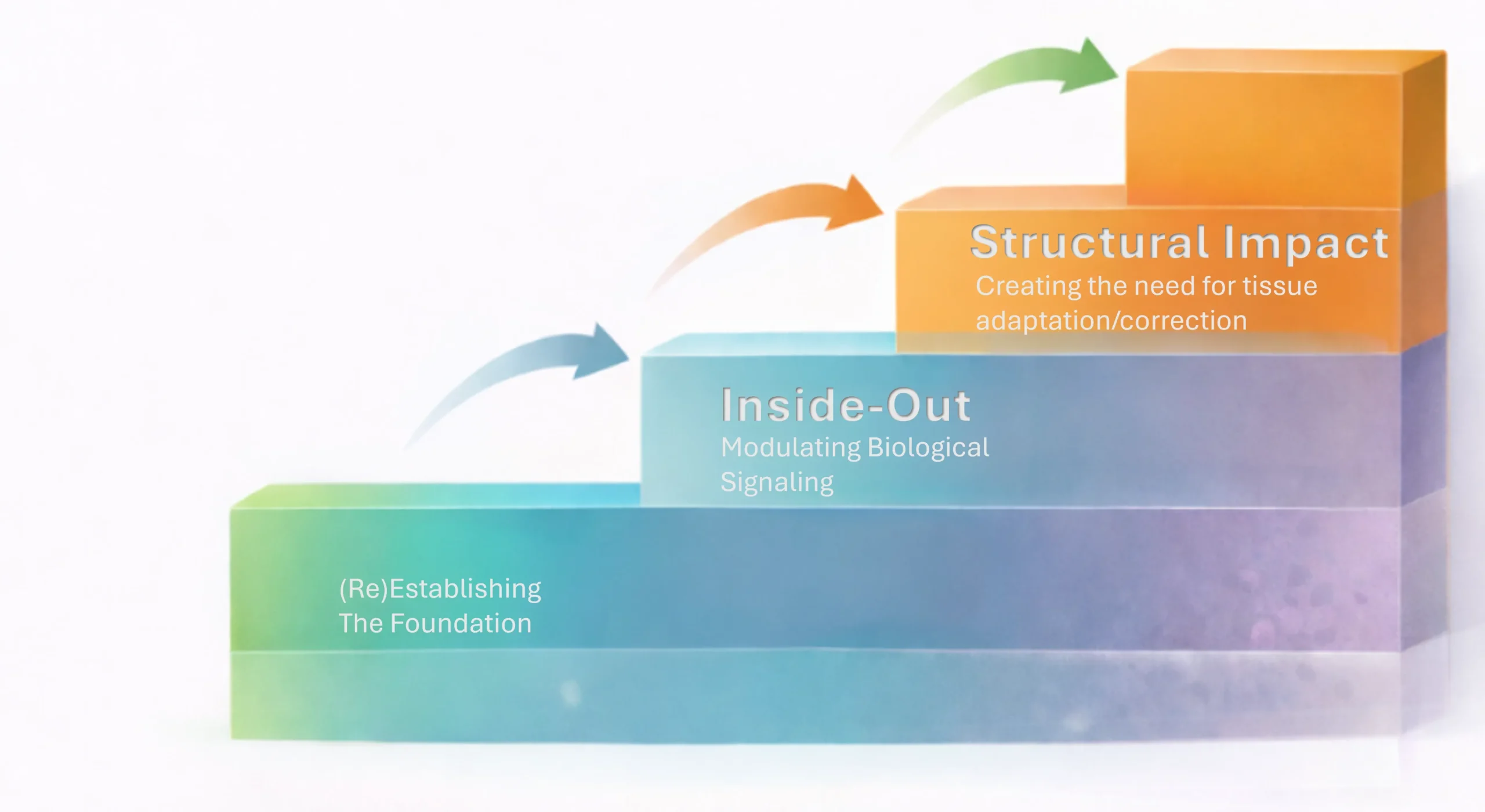
Combination as Orchestration, Not Accumulation
The most effective combination strategies are not those that maximize input, but those that maintain clarity of signal.
They allow the skin to:
- complete one adaptive response before initiating another
- distinguish modulation from challenge
- remain flexible rather than defensive
This approach does not simplify treatment planning. It makes it more precise.
Combination treatments will continue to evolve as technologies advance. The decisive factor will not be how many tools are available, but how well they are orchestrated.
Sustainable outcomes are built when combinations are used to expand biological capacity, not consume it.
This requires a shift in focus – from what can be combined, to when, why, and how combinations are introduced.
References
This article is inspired by a body of peer-reviewed research and clinical literature, including but not limited to – if you have any questions, reach out to us:
Elias PM, Hatano Y, Williams ML.
Basis for the barrier abnormality in atopic dermatitis: outside–inside–outside pathogenic mechanisms.
Journal of Allergy and Clinical Immunology. 2008;121(6):1337–1343.
https://doi.org/10.1016/j.jaci.2008.01.022
https://pubmed.ncbi.nlm.nih.gov/18329087/
Proksch E, Brandner JM, Jensen JM.
The skin: an indispensable barrier.
Experimental Dermatology. 2008;17(12):1063–1072.
https://doi.org/10.1111/j.1600-0625.2008.00786.x
https://onlinelibrary.wiley.com/doi/10.1111/j.1600-0625.2008.00786.x
Kammeyer A, Luiten RM.
Oxidation events and skin aging.
Ageing Research Reviews. 2015;21:16–29.
https://doi.org/10.1016/j.arr.2015.01.001
https://pubmed.ncbi.nlm.nih.gov/25653189/
Fisher GJ, Varani J, Voorhees JJ.
Looking older: fibroblast collapse and therapeutic implications.
Archives of Dermatology. 2008;144(5):666–672.
https://doi.org/10.1001/archderm.144.5.666
https://jamanetwork.com/journals/jamadermatology/article-abstract/419693
Hamblin MR.
Mechanisms and applications of the anti-inflammatory effects of photobiomodulation.
AIMS Biophysics. 2017;4(3):337–361.
https://doi.org/10.3934/biophy.2017.3.337
https://pubmed.ncbi.nlm.nih.gov/28748217/
Alam M, Han S, Pongprutthipan M, et al.
Efficacy of a needling device for the treatment of acne scars: a randomized clinical trial.
JAMA Dermatology. 2014;150(8):844–849.
https://doi.org/10.1001/jamadermatol.2013.8687
https://jamanetwork.com/journals/jamadermatology/fullarticle/1879091
Sorrell JM, Caplan AI.
Fibroblast heterogeneity: more than skin deep.
Cell and Tissue Research. 2004;317(1):49–57.
https://doi.org/10.1007/s00441-004-0934-z
https://journals.biologists.com/jcs/article-abstract/117/5/667/27913/Fibroblast-heterogeneity-more-than-skin-deep
Hardman MJ, Ashcroft GS.
Estrogen, not intrinsic aging, is the major regulator of delayed human wound healing in the elderly.
Genome Biology. 2008;9:R80.
https://doi.org/10.1186/gb-2008-9-5-r80
https://genomebiology.biomedcentral.com/articles/10.1186/gb-2008-9-5-r80
Rinnerthaler M, Bischof J, Streubel MK, Trost A, Richter K.
Oxidative Stress in Aging Human Skin.
Biomolecules. 2015;5(2):545–589.
https://doi.org/10.3390/biom5020545
https://www.mdpi.com/2218-273X/5/2/545
 English