


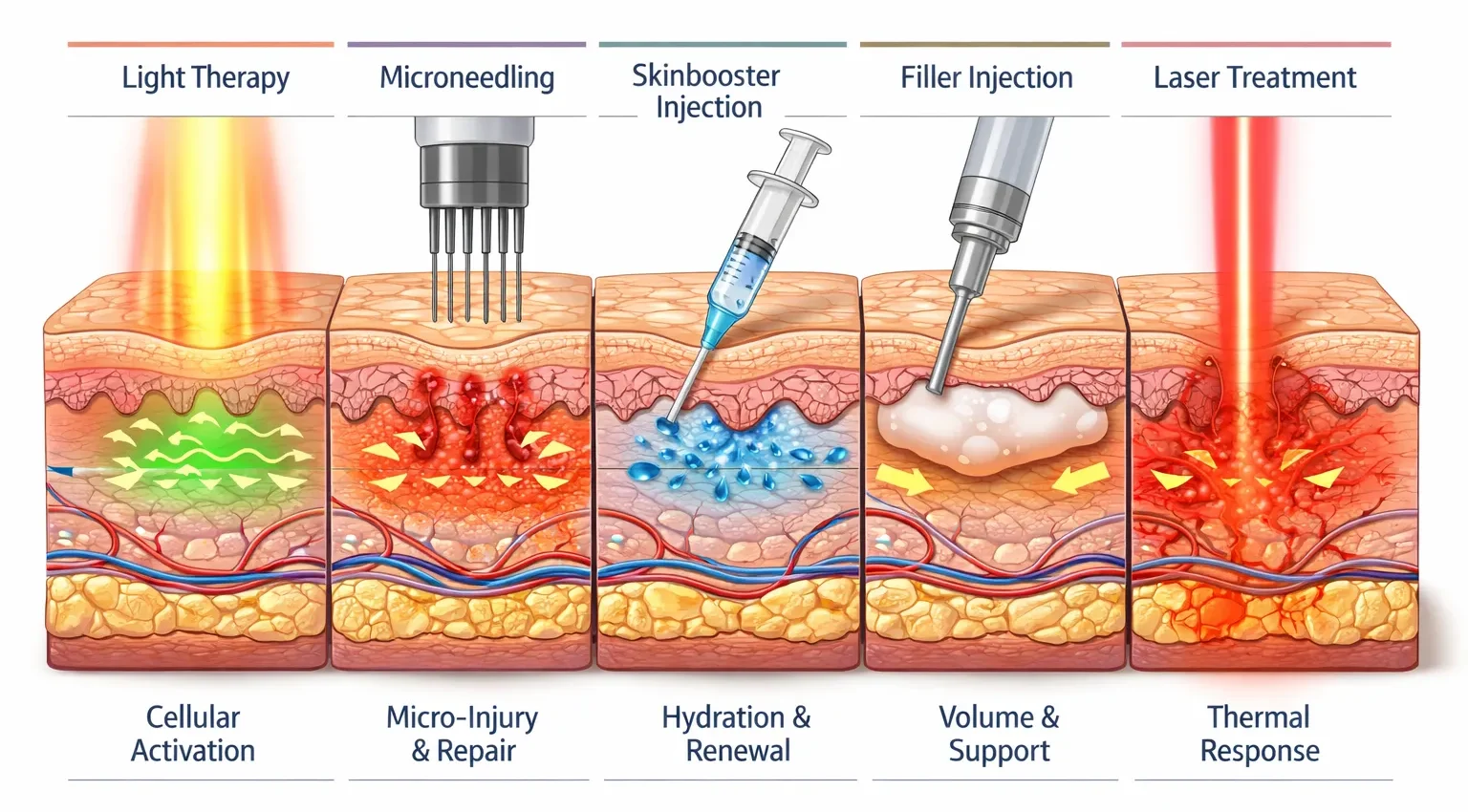

Aesthetic medicine is often discussed in terms of technologies: devices, injectables, energy levels, wavelengths and protocols. In practice, however, technologies do not act on their own. Their effect is determined by how the skin interprets and responds to the input they introduce. Input from aesthetic technologies can be a physical impact like DermaPen or microneedling, introduction of a substance the skin is intended to interact with like fillers, toxins and skinboosters, or energy that can be light, radiofrequency, cold, heat or high power laser energy – the input takes many shapes and forms.
Understanding this interaction between these myriad of inputs, helps explain why identical technologies (or marketed towards the same purpose and even technological compared to each other) can produce durable improvement in one context and diminishing or inconsistent outcomes in another. The difference is not primarily technical – it is biological.
Aesthetic Technologies don’t fail the skin.
They more often reveal the biological state the skin is actually already in.
The outcome depends less on the tool – and more on what the skin is prepared to integrate
Skin does not receive interventions passively. It evaluates them.
Every aesthetic treatment introduces information into a system designed to continuously assess risk, relevance, and priority. The skin does not distinguish between “treatment” and “stimulus” based on intent. It distinguishes based on type, magnitude, frequency, and context.
This is why treatment outcomes cannot be understood solely by modality or mechanism of action. The same input may be processed as constructive guidance by our cellular systems in one context and as stress in another. The deciding factor is the skin’s current capacity to integrate that input.
That is also why we see in some patients that cheaper or inferior technologies in “lucky” cases can indeed produce good outcomes – but not necessarily work in the broader context of patients in all parts of the world and with all types of skin. More advanced (and also often more expensive) technologies and treatments in many cases can deliver more results in more patients, yet it is not necessarily a guarantee if still used in patients that does not have the capacity to respond as “intended”
Signals and Stress: How Technologies Are Classified Biologically
From the skin’s perspective, aesthetic technologies tend to fall along a spectrum between
biological signaling and biological stress.
Some interventions primarily modulate cellular behavior. They influence communication, metabolism, or repair pathways without requiring the skin to enter a defensive state. These inputs rely on the skin’s ability to adapt without mobilizing extensive inflammatory or survival mechanisms.
Other interventions deliberately introduce controlled disruption. Mechanical injury, thermal exposure, or structural challenge, activating repair cascades through stress. When delivered appropriately, for the right patient and allowed to resolve, this stress can drive effective regeneration.
Both approaches can be valid. Problems arise when stress-based inputs are repeated without sufficient resolution or used in a patient where the skin is already in survival mode, or when signaling-based approaches are layered onto skin that is already operating defensively. In these situations, visible results may still occur, but at increasing biological cost, or only for a very short period of time.
Why the Same Technology Behaves Differently Over Time
Aesthetic technologies do not stop working – contexts change.
As treatments accumulate, the biological environment shifts. Barrier integrity, inflammatory tone, vascular responsiveness, and metabolic demand all influence how subsequent interventions are processed. And in this context, we can also talk about the general perspective of the patients – the age, the level of stress, metabolism, diet, exercise, general wellbeing. When these factors are favorable, treatments remain efficient. When they are not, the same protocols require adjustment.
This is why technologies that initially perform well may later produce narrower margins of tolerance or less predictable outcomes. The limitation is not the device or product, but the altered interpretive state of the skin.
- Failing to account for this shift leads to reactive adjustments.
- Accounting for it enables strategic planning.
In technology-driven treatment plans, recovery is often treated as time between interventions (or the time in between the next set of intervention can be initiated). Biologically, recovery is the phase in which the meaning of the previous intervention is implemented – or where biology in principle obtains the most effect from the intervention.
If positive signaling is initiated and stress responses return to baseline, the skin regains flexibility. If resolution is incomplete, the next intervention is layered onto an unresolved state. Over time, this changes baseline behavior, can cause cellular confusion, and can even start to deteriorate the skin and for the practitioner narrows the future treatment options – without this is being realised. A bias is established towards “it worked before, so why should it not work now”.
This is particularly relevant in multi-modality and high-frequency protocols, where the cumulative effect of unresolved input may outweigh the benefit of any single intervention.
This is a very well known biological effect, that is utilized also significantly in pharma as well as vaccines – Treating to often can have a negative effect, treating too seldom can make the treatment ineffective – it is a matter of timing to allow the intervention to work, boost the positive stimulation further when it reaches it’s optimum (and before it declines or plateau), but also avoiding the urge to do everything too fast or too aggressively. Suddenly the positive outcomes obtained can turn around and cause disruption, stress and moving the skin into survival mode rather than regeneration mode.
When Optimization Reduces Capacity
As aesthetic technologies become more efficient, it becomes easier to intensify protocols. Shorter intervals, higher settings, and layered approaches may improve short-term outcomes while quietly compressing recovery windows.
Optimization is not about “most powerful” or “fastest result” – this is marketing hype, and often a driver for clinics to drive through more patients – biologically, the cells often do not need or want this more powerful or fast approach.
The result is often not immediate failure, but reduced capacity for the cells to respond positively. The skin remains responsive, but within tighter constraints. Treatments that were once straightforward require caution. Flexibility is lost.
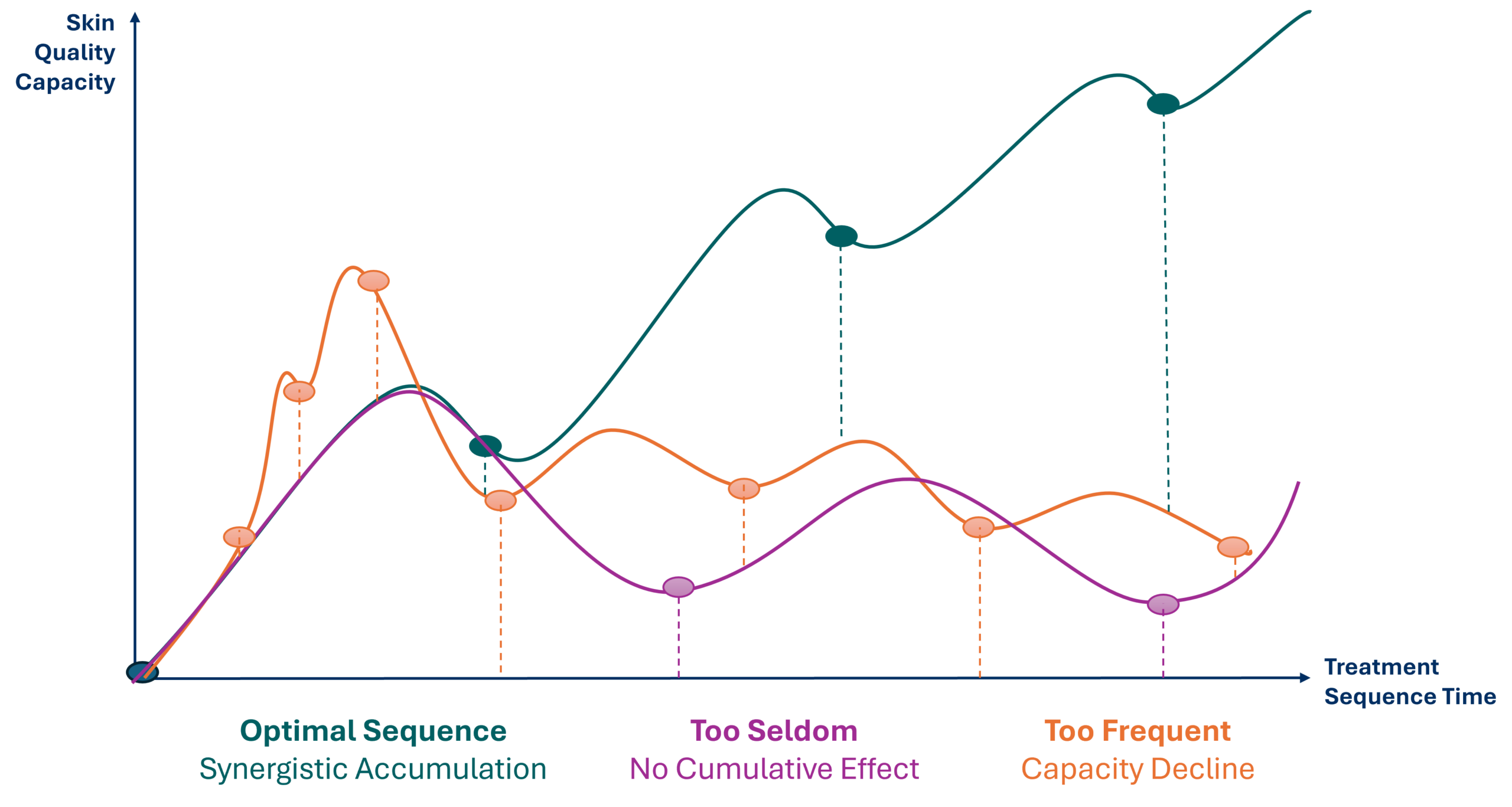
This limitation is often mistaken for that the skin of the patient is further in the aging process, more sensitive, or considered as treatment fatigue. In reality, it reflects a system that has been optimized for output rather than preserved for adaptability and for optimized biological or cellular stimulation.
Capacity as the Relevant Outcome Measure
Visible improvement is an outcome. Capacity is a trajectory.
Capacity determines whether the skin can continue to respond over time – to tolerate interventions, recover efficiently, and adapt as strategies evolve. Technologies that preserve capacity extend clinical options. Technologies applied without regard for capacity eventually restrict them.
Evaluating treatments through this lens shifts the focus from immediate effect to long-term responsiveness. It does not diminish the value of results – it places the specific technology where it belongs in biological terms.
Toward a More Coherent Use of Aesthetic Technology
Understanding how skin interprets technological input allows treatments to be selected and sequenced with greater precision.
When signaling, stress, and resolution are considered together, technologies become tools rather than drivers. Outcomes become more consistent, recovery more predictable, and long-term strategies more flexible.
As aesthetic medicine continues to advance, the decisive factor will not be what technologies can deliver, but what the skin is prepared to integrate.
References
This article is inspired by a body of peer-reviewed research and clinical literature, including but not limited to – if you have any questions, reach out to us:
- Medzhitov R.
Origin and physiological roles of inflammation.
Nature. 2008;454(7203):428–435.
https://doi.org/10.1038/nature07201
https://www.nature.com/articles/nature07201
- Nathan C, Ding A.
Nonresolving inflammation.
Cell. 2010;140(6):871–882.
https://doi.org/10.1016/j.cell.2010.02.029
https://www.cell.com/cell/fulltext/S0092-8674(10)00182-0
- Kupper TS, Fuhlbrigge RC.
Immune surveillance in the skin.
Nature Reviews Immunology. 2004;4:211–222.
https://doi.org/10.1038/nri1310
https://www.nature.com/articles/nri1310
- Proksch E, Brandner JM, Jensen JM.
The skin: an indispensable barrier.
Experimental Dermatology. 2008;17(12):1063–1072.
https://doi.org/10.1111/j.1600-0625.2008.00786.x
https://onlinelibrary.wiley.com/doi/10.1111/j.1600-0625.2008.00786.x
- Elias PM.
Skin barrier function.
Current Allergy and Asthma Reports. 2008;8(4):299–305.
https://doi.org/10.1007/s11882-008-0048-0
https://link.springer.com/article/10.1007/s11882-008-0048-0
- Pilkington SM, Bulfone-Paus S, Griffiths CEM, Watson REB.
Inflammaging and the skin.
Journal of Investigative Dermatology. 2021;141(4):1087–1095.
https://doi.org/10.1016/j.jid.2020.11.006
https://www.jidonline.org/article/S0022-202X(20)32294-6/fulltext
- Singer AJ, Clark RAF.
Cutaneous wound healing.
New England Journal of Medicine. 1999;341(10):738–746.
https://doi.org/10.1056/NEJM199909023411006
https://www.nejm.org/doi/full/10.1056/NEJM199909023411006
 English